
New Synagogue Berlin, Jewish Quarter & Third Reich History Tours
The New Synagogue Berlin on Oranienburger Straße is one of the most visible landmarks of Jewish heritage in the city. It connects architecture, memory, persecution, resistance and the fragile return of Jewish life to Berlin’s historic centre.
This guide helps you understand what to see around the New Synagogue, which nearby sites matter, and which guided tours provide deeper context on Jewish Berlin, the Third Reich and World War II history.
Best Guided Tours for Jewish Berlin, the Third Reich and WWII History
Berlin’s Jewish history cannot be understood through one building alone. The strongest tours connect the New Synagogue and the former Jewish quarter with sites of Nazi persecution, resistance, wartime destruction and the divided city that followed.
Nazi Berlin and the Jewish Community Tour
A focused option for visitors who want Jewish community history, persecution under National Socialism and memorial culture in one guided route.
View Jewish History TourThird Reich & Cold War Walking Tour
A compact route for understanding how Nazi Berlin, wartime memory and Cold War history overlap in the city centre.
View Third Reich & Cold War TourThird Reich, Hitler and WWII Walking Tour
A broader World War II walking tour for visitors who want political history, dictatorship, war sites and Berlin’s role in the Nazi period.
View WWII History TourWhy the New Synagogue Matters
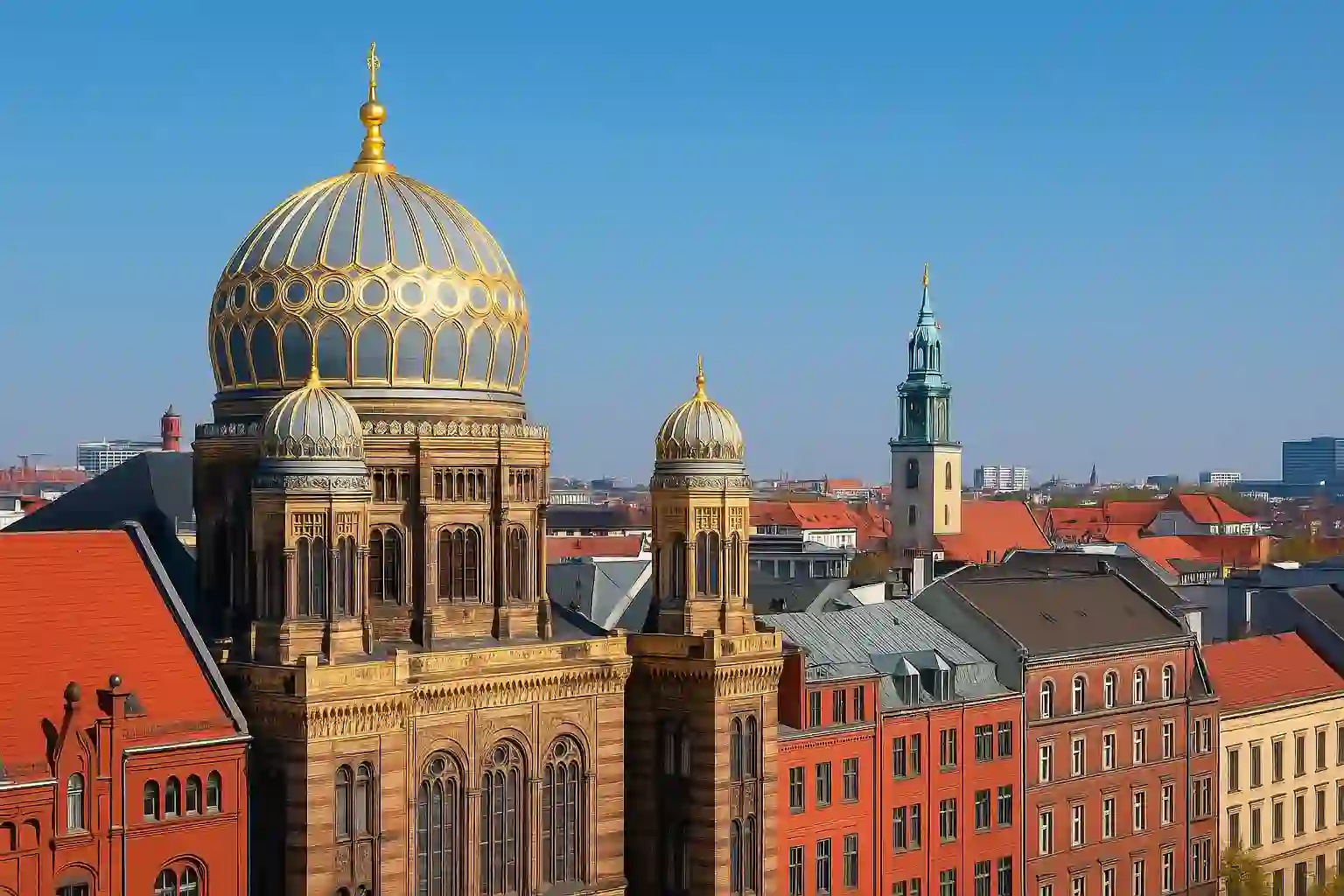
The New Synagogue Berlin was inaugurated in 1866 and became one of the great symbols of Jewish life in 19th-century Berlin. Its golden dome and Moorish Revival façade made it a highly visible statement of confidence, belonging and cultural presence.
That visibility also makes the building historically charged. During the Nazi period, Jewish life in Berlin was attacked, excluded and destroyed. The synagogue was damaged during the November pogrom of 1938 and later suffered further destruction during World War II.
Today, the restored front section and the Centrum Judaicum are places of documentation, remembrance and cultural continuity. The site is not only an architectural landmark. It is a point of entry into Berlin’s Jewish history before, during and after National Socialism.
What Makes This Site Different from Generic Berlin History Stops
The New Synagogue is not just another Berlin landmark. It is a story of public visibility. When it opened in 1866, it was Germany’s largest Jewish place of worship, with around 3,200 seats, and its Moorish Revival architecture and gilded dome made Jewish life deliberately visible in the city centre.
That visibility was later attacked, damaged and partly erased. After reunification, Berlin did not simply rebuild the whole lost synagogue as if nothing had happened. The restored façade and dome stand together with visible traces of absence: stones in the ground mark the former scale of the original building and make the destruction readable in the site itself.
This is what separates the New Synagogue from many generic tourist stops. It is a place where architecture, Jewish emancipation, Nazi violence, wartime destruction and post-reunification memory policy can be read in one physical structure.
What to See Near the New Synagogue Berlin
| Place | Why it matters |
|---|---|
| Oranienburger Straße | Historic centre of Jewish Berlin and the street where the New Synagogue stands. |
| Hackescher Markt | Useful starting point for exploring the former Jewish quarter and central Berlin on foot. |
| Otto Weidt’s Workshop | A powerful site connected to rescue, forced labour and resistance during the Nazi period. |
| Stolpersteine | Small memorial stones that make the deportation and murder of Jewish Berliners visible in the streetscape — an important counterpoint to the monumental visibility of the New Synagogue. |
| Topography of Terror | A central documentation site on the Nazi terror apparatus, located on the former grounds of key Nazi institutions. |
Visiting Information
The New Synagogue is located at Oranienburger Straße 28–30 in Berlin-Mitte. The area is easy to reach by public transport and can be combined with Hackescher Markt, Museum Island, the Jewish Museum, the Topography of Terror or other memorial sites depending on your route.
Opening hours, security rules, exhibitions and admission can change. Before visiting, check the official website of the Centrum Judaicum for the latest information.
Map: New Synagogue Berlin & Nearby History Sites
The New Synagogue sits in Berlin-Mitte, close to several important places for Jewish history, museum visits and political memory.
Frequently Asked Questions: New Synagogue Berlin & Jewish History Tours
Is the New Synagogue Berlin still an active synagogue?
Is the dome of the New Synagogue Berlin made of real gold?
Which tour is best if I want Jewish history and Nazi-era context?
Can I visit the New Synagogue Berlin without a guided tour?
How much time should I plan for this area?
Jewish Life Today in Berlin
Beyond its historical significance, the New Synagogue stands as a symbol of Jewish life returning to the heart of Berlin. The building points to a deeper story: Jewish Berlin is not only a subject of memory, but also a living community, cultural presence and continuing part of the city.
For visitors, this perspective becomes stronger when the synagogue is connected with smaller forms of remembrance in the city, especially the Stolpersteine in Berlin. Together, the golden dome and the memorial stones show two very different scales of memory: one highly visible landmark and thousands of individual traces embedded in everyday streets.
