
Berlin Treptow – Between History, River & Renewal
The Soul of the Southeast
Treptow is not a place that shouts for attention. It reveals itself slowly — in the sound of bicycles along the river path, in the echo of boats passing under bridges, and in the faint traces of its industrial and political past. Those who walk through Treptow find a Berlin that still feels genuine: neither touristy nor polished, but quietly alive.
A Short History of Treptow
Treptow's story begins in the 19th century, when Berlin expanded rapidly as an industrial city. The riverside made it an ideal location for shipyards, chemical plants and mechanical workshops. Workers built their homes close to the factories, forming tight-knit communities that gave the district its straightforward, modest character.
During the GDR years, Treptow became a symbol of socialist industry. Large factories defined the local economy, while the border along the River Spree separated East from West — a visible and emotional divide. Yet everyday life continued: children played in courtyards, families walked through Plänterwald, and Sunday picnics took place under the same trees that still stand today.
After 1989, the Wall fell, and Treptow — like much of East Berlin — began to change. Abandoned factories became cultural spaces, tech companies moved into riverside lofts, and artists found inspiration in the rough beauty of old industrial walls. What remained was the soul of the district: practical, working-class, and deeply connected to the Spree.
Treptower Park – A Landscape of Memory
The heart of Treptow is its park — 88 hectares of lawns, lakes and monuments stretching along the river. Opened in 1888, Treptower Park was designed as a public garden for Berlin's growing population, combining romantic pathways with classical landscaping.
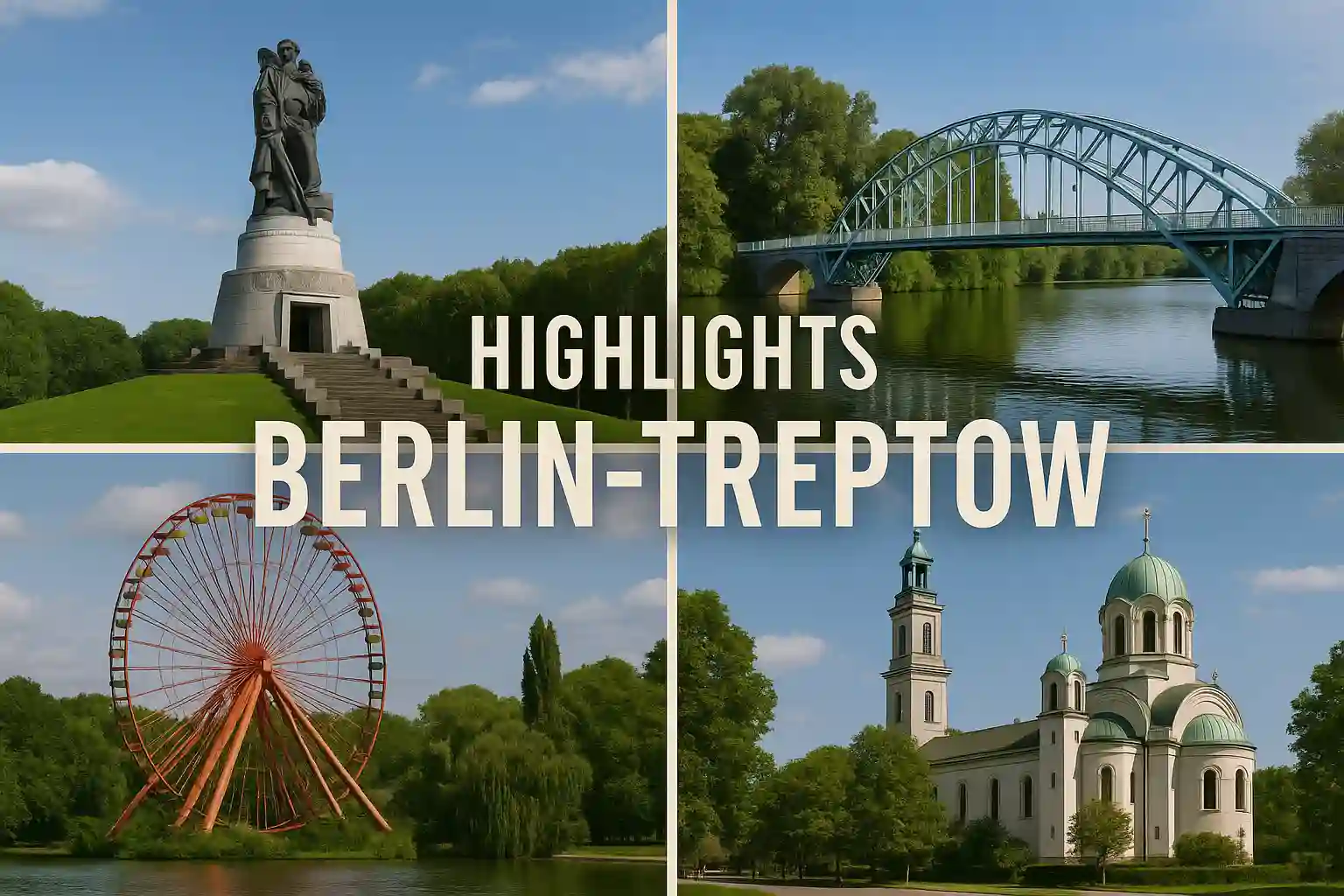
At its centre stands one of Europe's most imposing war memorials: the Soviet War Memorial, built between 1946 and 1949 to commemorate more than 80,000 Soviet soldiers who died in the Battle of Berlin. The memorial's scale is overwhelming — a vast axis lined with marble sarcophagi, leading to a towering bronze statue of a soldier holding a rescued child. It is both political and profoundly human, a reminder of the city's destruction and its recovery.
Around it, the park softens into meadows and water. Locals rent pedal boats, cycle along the Spree, or stop at small cafés near the harbour. Treptower Park is both a place of remembrance and a living landscape — Berlin's ability to hold history and leisure in the same space.
Alt-Treptow – Between Bridges and Brick Factories
Alt-Treptow, the oldest part of the district, sits where the Spree bends sharply towards the centre. It is here that Berlin's industrial heritage becomes visible: long brick façades, restored warehouses, and converted docks.
The Arena Berlin, once a 1920s bus depot, now hosts concerts, exhibitions and cultural festivals. Beside it floats the Badeschiff, a swimming pool anchored in the river — a unique blend of architecture and playfulness. Across the water, the silver figures of Molecule Man rise from the Spree, symbolising unity and connection between Berlin's once divided districts.
Nearby, the modern Treptowers mark the district's transformation. Their mirrored façades reflect the river and the sky, a contrast to the red brick of the past. Alt-Treptow shows Berlin in miniature: a dialogue between history and progress, memory and design.
Plänterwald and Spreepark – Nature and Nostalgia
South of Treptower Park, the forest of Plänterwald stretches for over two square kilometres. This quiet woodland was once part of the royal hunting grounds and later became one of East Berlin's most beloved recreation areas. Its network of walking paths and cycling routes provides a rare sense of wilderness within the city.
Hidden among the trees lies the Spreepark, once the GDR's only amusement park. Opened in 1969, it was filled with colourful rides and a giant Ferris wheel overlooking the river. After reunification, the park was abandoned, leaving behind a surreal landscape of rusting dinosaurs and overgrown tracks.
In recent years, guided tours have reopened the site, revealing the poetic beauty of decay. The Spreepark has become a symbol of Berlin's layered identity — a place where memory, ruin and hope coexist.
Life by the Water
The River Spree defines Treptow's geography and its spirit. It is both boundary and connection — a lifeline that has shaped the district for centuries. Walking along the riverside promenade, one passes houseboats, rowing clubs, and cafés with wooden terraces floating just above the water.
One of Treptow's hidden gems is the Insel der Jugend — the Island of Youth. Reached by a small footbridge from Treptower Park, it hosts open-air concerts, cultural events and a riverside café. Families come for picnics, students for summer evenings, and photographers for the light reflected on the water. From here, Berlin feels more like a coastal town than a capital — open, relaxed, and quietly alive.
Further downstream, boat tours depart towards Köpenick and Müggelsee, offering a slow way to experience the city. From the deck, Treptow appears as a sequence of trees, docks and towers — a district defined by its connection to the river.
Architecture and Urban Character
Treptow's architecture reflects every period of Berlin's evolution. Along Elsenstraße and Puschkinallee, red-brick industrial buildings tell stories of 19th-century labour. The clean lines of GDR-era housing blocks still dominate parts of the district, while new glass structures mirror the Spree's light.
One of the most interesting restorations is the Eierhäuschen, a riverside restaurant originally opened in the 19th century. After decades of decay, it has been carefully rebuilt and now houses both a cultural venue and a café. This combination of respect for history and openness to change captures Treptow's essence perfectly.
The result is a district with no single face, but many layers. Its buildings form a visual archive of Berlin's past — industrial, socialist, and modern at once.
Culture and Community
Beyond its architecture, Treptow's identity lives in its people. Many artists, musicians and small entrepreneurs have settled here, drawn by affordable spaces and the area's slower rhythm. Inside renovated warehouses, you'll find design studios, rehearsal rooms and small art galleries.
Venues like the Arena Club host concerts and events that attract both locals and visitors. During summer, open-air cinemas and riverside markets bring the community together. What distinguishes Treptow's culture is its authenticity: creativity without spectacle, art without pretension.
Practical Tips for Your Visit
Getting There:
Treptow is easily accessible by S-Bahn. The station Treptower Park connects directly to the city centre on lines S8, S9, and S85 (Alexanderplatz, Hauptbahnhof, and the airport). Cycling is one of the best ways to explore: dedicated bike paths run along the Spree and through the forest.
Best Time to Visit:
Spring and autumn are ideal, when the park blooms or the leaves turn golden. Summers are lively, with open-air events and long days by the water. Weekday mornings offer the most peaceful atmosphere for photography and quiet reflection.
Local Vibe:
Treptow suits travellers who enjoy walking, photography, history, or simply quiet observation — it's a place for those who prefer authenticity over attraction. Take your time, explore slowly, and let the district reveal itself.
Duration:
A half-day allows you to visit Treptower Park and the Soviet Memorial, walk along the Spree, and explore Alt-Treptow. A full day includes Plänterwald forest, Spreepark tours (book in advance), and a boat trip or riverside meal.
Nearby Connections:
You can easily reach Kreuzberg via the Oberbaum Bridge, or head south to Köpenick, Berlin's most scenic old town. The riverside path connects Treptow to Friedrichshain and beyond.
Hidden Details Worth Discovering
- Molecule Man Sculpture – Three 30-meter aluminum figures meeting in the Spree, symbolizing unity between Treptow, Kreuzberg, and Friedrichshain
- Eierhäuschen – Historic riverside restaurant and cultural venue with outdoor seating overlooking the water
- Zenner Beer Garden – Traditional riverside beer garden in Treptower Park, perfect for sunset drinks
- Archenhold Observatory – Home to the world's longest movable telescope, offering public stargazing events
- Spreepark Guided Tours – Explore the abandoned GDR amusement park with expert commentary (booking required)
Reflection – Between Memory and Flow
Treptow is Berlin in slow motion. It doesn't dazzle or perform; it reflects. Here, the river becomes a mirror — of the city's past, its transformations, and its capacity for renewal.
The factories and towers, the parks and bridges, the monuments and cafés — they all speak of a city that never forgets where it came from. To walk through Treptow is to see Berlin's pulse beneath the surface: industrial, reflective, quietly enduring.
Those who take the time to explore will discover something rare — a district that still breathes with the rhythm of real life, balanced between history and the flowing water of the Spree.
