
Topography of Terror Museum Berlin
The Topography of Terror Museum Berlin is a free documentation center on the former grounds of the Gestapo, SS and Reich Security Main Office. For visitors, it is one of the clearest places in Berlin to understand how Nazi terror was organized from offices, files, police power and institutions.
Quick answer: is the Topography of Terror worth visiting?
Yes. The Topography of Terror Berlin is worth visiting because it stands on the original site where the Gestapo, SS and Reich Security Main Office operated. It is free, central and especially useful if you want to understand Nazi terror as an administrative system rather than only as a collection of isolated crimes.
Plan at least 90 minutes for a focused visit. If you want deeper context, combine the museum with a Third Reich walking tour or with a separate visit to Sachsenhausen Memorial in Oranienburg.
Why is the Topography of Terror important?
The Topography of Terror is important because it explains the institutional machinery behind Nazi persecution. The site was not a remote battlefield or a distant camp. It was a command center in Berlin where police power, bureaucracy, ideology and violence were connected.
Visitors see the historical ground where the Gestapo and SS helped organize surveillance, persecution, deportation, forced labor and murder. This makes the museum different from many other memorial sites: the place itself is part of the evidence.
How does the Topography of Terror connect to the Nazi camp system?
The Topography of Terror connects Berlin city history with the wider Nazi camp system. It shows how state institutions, police agencies and SS structures turned ideology into practical systems of arrest, detention, deportation and forced labor.
A common misunderstanding is to think only of a few famous camps. In reality, the Nazi camp universe included concentration camps, forced-labor camps, prisoner-of-war camps, transit camps, ghettos, killing centers and many other incarceration sites. The United States Holocaust Memorial Museum describes a system of more than 44,000 camps and other incarceration sites, including ghettos, created by Nazi Germany and its allies between 1933 and 1945.
Sachsenhausen
Sachsenhausen in Oranienburg is the closest major concentration camp memorial to Berlin. More than 200,000 people were interned there between 1936 and 1945.
Near Berlin Major memorial site Strong day-trip optionRavensbrück
Ravensbrück, north of Berlin near Fürstenberg/Havel, was the central women’s concentration camp in the German Reich. It is important for understanding women prisoners, forced labor, medical violence and the northern camp landscape.
Women’s concentration camp North of Berlin Full-day visitDachau
Dachau, near Munich, opened in March 1933 and became a model for later concentration camps. It is not near Berlin, but it is central for understanding the early development of the concentration camp system.
Near Munich Opened in 1933 Model campBuchenwald
Buchenwald near Weimar was one of the largest concentration camp complexes inside Germany. By April 1945, nearly 280,000 people had been held in Buchenwald and its 139 subcamps.
Near Weimar Large subcamp system Forced laborNeuengamme
Neuengamme, near Hamburg, was the largest concentration camp in northern Germany. It helps visitors understand how forced labor and satellite camps expanded the Nazi camp system.
Near Hamburg Northern Germany Forced labor systemAuschwitz-Birkenau
Auschwitz-Birkenau was located in German-occupied Poland and became the deadliest Nazi camp complex. It is not near Berlin, but it is essential for understanding deportation, forced labor and extermination.
Occupied Poland Killing center Central Holocaust siteWhich concentration camp memorials can you visit from Berlin?
From Berlin, the most realistic concentration camp memorial visit is Sachsenhausen Memorial in Oranienburg. Ravensbrück is also reachable, but it is farther away and better suited for visitors with a full day and a specific interest in the history of women prisoners, forced labor and medical crimes.
Sachsenhausen Memorial
Sachsenhausen is the closest major concentration camp memorial to Berlin. It works as the strongest continuation after the Topography of Terror because it connects SS administration, imprisonment, forced labor and memory culture.
Ravensbrück Memorial
Ravensbrück is a serious full-day option north of Berlin. It is especially important for visitors who want to understand women prisoners, forced labor, medical abuse and the international prisoner population.
Wannsee Conference House
The House of the Wannsee Conference is not a concentration camp. It is one of the most important Berlin-area sites for understanding the bureaucratic planning of the “Final Solution.”
Should you visit independently or book a guided tour?
The Topography of Terror can be visited independently because the main exhibition is well documented and free. A guided tour makes more sense if you want to connect the site with nearby Nazi-era locations, Cold War history, the Holocaust Memorial, the former Führerbunker area or Sachsenhausen.
| Visit option | Best for | Time needed | What you get |
|---|---|---|---|
| Self-guided museum visit | Visitors who want a focused, free museum visit | 90 minutes | Main exhibition, outdoor trench exhibition, site remains and Berlin Wall context |
| Third Reich walking tour | First-time visitors who want city context | 2 to 3 hours | Topography of Terror plus nearby Nazi-era and memorial sites explained as one route |
| Sachsenhausen day trip | Visitors who want deeper camp-system context | Half day to full day | Memorial visit outside Berlin with stronger focus on imprisonment, forced labor and SS camp structure |
How did people get to concentration camps and killing centers?
People reached Nazi camps and killing centers through different routes. Some were arrested by police or Gestapo units in Germany. Others were deported from occupied territories, ghettos, transit camps or prisons. Many were transported by rail in overcrowded trains under brutal conditions.
Rail transport became central to the deportation system because the European rail network allowed German authorities to move large numbers of people across borders and occupied territories. Deportations were often disguised with bureaucratic language, while the real destinations were forced-labor sites, concentration camps or killing centers.
In the final phase of the war, as Allied forces approached, the SS forced tens of thousands of prisoners onto death marches. Many died from exhaustion, hunger, exposure or shootings along the route. Sachsenhausen itself was evacuated in April 1945, when more than 30,000 prisoners were forced to march northwest.
What can you see inside the Topography of Terror?
The main exhibition inside the Documentation Center is “Topography of Terror: Gestapo, SS and the Reich Security Main Office.” It explains how the central institutions of Nazi repression functioned, how ideology became policy and how policy became systematic persecution.
Visitors are guided chronologically from the rise of National Socialism to the aftermath of World War II. The exhibition combines historical photographs, official documents, maps, letters and biographical examples. This documentary style helps visitors follow the evidence without theatrical staging.
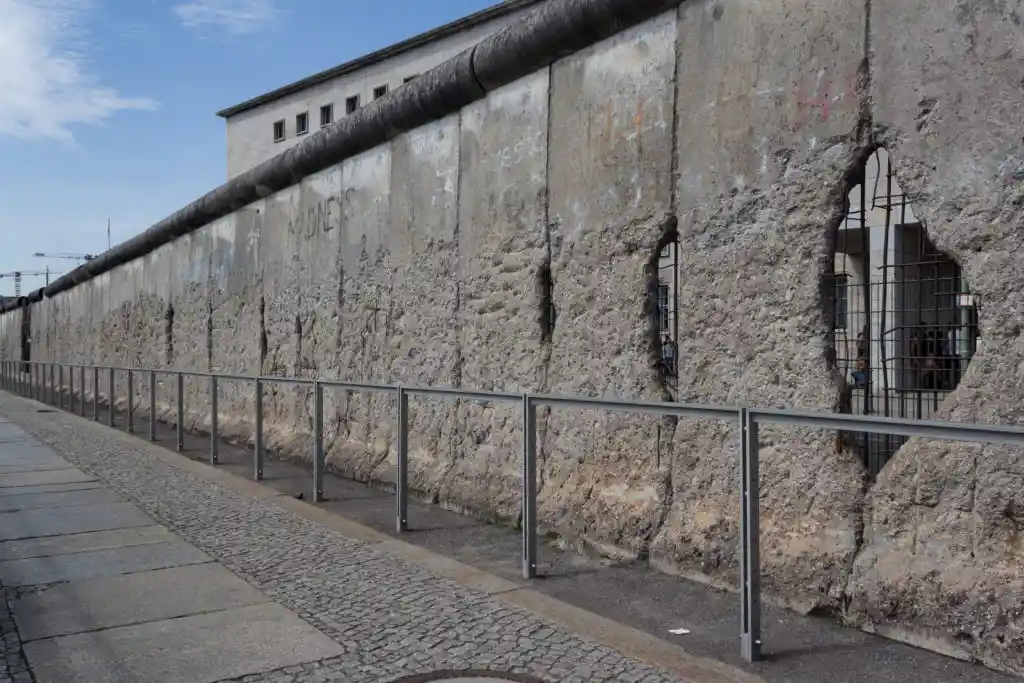
Outside the building, the preserved cellar remains of the former Gestapo headquarters and the outdoor exhibition create a direct connection between the historical site and the crimes planned or coordinated there. Nearby Berlin Wall remains add another layer of German history in the same urban space.
Topography of Terror Berlin: opening hours, address and practical tips
- Address: Niederkirchnerstraße 8, 10963 Berlin, close to the Berlin Wall remains.
- Opening hours: Exhibitions are normally open daily from 10:00 to 20:00.
- Admission: Free entry.
- Nearest transport: U-Bahn Kochstraße, S-Bahn Anhalter Bahnhof or Potsdamer Platz.
- Recommended visit length: 90 minutes for the main exhibition; longer if you read deeply or combine nearby sites.
- Languages: The main visitor experience is accessible in German and English.
- Accessibility: The site is generally suitable for wheelchair users, with barrier-free paths and restrooms.
- Photography: Photography for personal use is usually possible, but respectful conduct is expected.
Last checked: 12 June 2026. Opening hours, closures, guided tour availability and visitor rules can change. Check the official site before visiting.
What is the best route after visiting the Topography of Terror?
The best route depends on how much time you have. For a short visit, connect the Topography of Terror with the Berlin Wall remains and Checkpoint Charlie. For a deeper memory route, continue to the Jewish Museum Berlin, the Holocaust Memorial or Sachsenhausen Memorial.
| Route | Stops | Best for |
|---|---|---|
| Short historical route | Topography of Terror → Berlin Wall remains → Checkpoint Charlie | Visitors with 2 to 3 hours in central Berlin |
| Memory route | Topography of Terror → Jewish Museum Berlin → Holocaust Memorial | Visitors focused on Jewish history, Nazi persecution and remembrance |
| Camp-system route | Topography of Terror → Sachsenhausen Memorial day trip | Visitors who want to connect Berlin administration with camp reality |
Map: Topography of Terror, nearby sites and camp memorials
The Topography of Terror is located close to several major Berlin history sites. Sachsenhausen and Ravensbrück are outside central Berlin, but they belong to the wider memory landscape that many visitors connect with this page.
Frequently Asked Questions: Topography of Terror Berlin
What is the Topography of Terror in Berlin?
The Topography of Terror is a documentation center and memorial site on the former grounds of the Gestapo, SS and Reich Security Main Office in Berlin. It explains how Nazi terror was organized through police power, bureaucracy and state institutions.
Is the Topography of Terror free?
Yes. Admission to the Topography of Terror exhibitions is free. The site is one of the most important free historical museums in central Berlin.
How long do you need for the Topography of Terror?
Most visitors should plan around 90 minutes for the main exhibition and outdoor areas. Visitors with a strong interest in Nazi history, documents and memorial sites may want two hours or more.
What makes the Topography of Terror different from other Holocaust memorials?
The Topography of Terror is located on the actual site of the former Gestapo, SS and Reich Security Main Office. This direct physical connection to Nazi power gives the museum a unique historical authenticity.
How many Nazi camps and incarceration sites existed?
The United States Holocaust Memorial Museum describes a system of more than 44,000 camps and other incarceration sites, including ghettos, established by Nazi Germany and its allies between 1933 and 1945.
Which concentration camp memorial is closest to Berlin?
Sachsenhausen Memorial in Oranienburg is the closest major concentration camp memorial to Berlin and can be visited as a half-day or day trip.
Can I visit Ravensbrück from Berlin?
Yes, Ravensbrück Memorial near Fürstenberg/Havel can be visited from Berlin, but it is farther away than Sachsenhausen and better suited for a full-day visit.
Should I book a guided tour for the Topography of Terror?
A guided tour is useful if you want to connect the Topography of Terror with nearby Nazi-era sites, the former Führerbunker area, the Holocaust Memorial, Checkpoint Charlie or Sachsenhausen Memorial.
How did prisoners get to concentration camps?
People were arrested, deported from occupied territories, moved from ghettos and transit camps, or transported by rail under brutal conditions. In the final months of the war, many prisoners were also forced onto death marches.
Is the Topography of Terror suitable for children and school groups?
The museum offers educational materials and guided tours for older students, especially from age 14 and up. Due to the serious and emotional nature of the content, it may not be suitable for young children.
Source notes and useful official links
This visitor guide uses official museum and memorial sources where possible. For opening hours, closures and guided tours, always check the official page before visiting.
- Topography of Terror Documentation Center – Official Site
- Topography of Terror – Directions, Opening Hours and Admission
- USHMM – Camp System Maps
- USHMM – Nazi Camps
- USHMM – German Railways and the Holocaust
- Sachsenhausen Memorial and Museum – Official Site
- Ravensbrück Memorial Museum – Official Site
- Dachau Concentration Camp Memorial Site
- Buchenwald Memorial
