
Berlin-Friedrichshain – Street Art, Nightlife & Urban Soul
East Side Gallery – Art on the Remains of a Wall
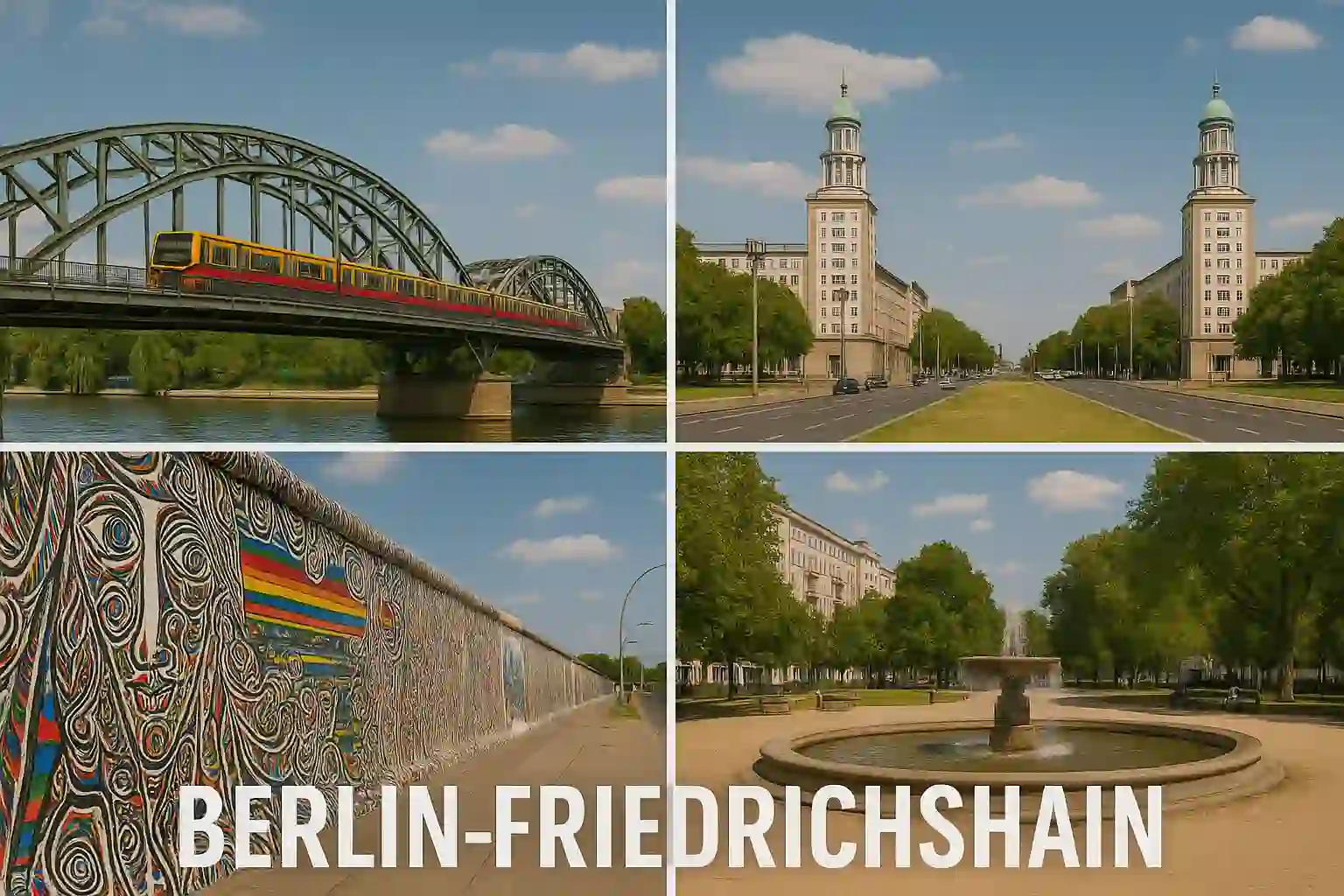
Few places capture Berlin's transformation better than the East Side Gallery. Stretching 1.3 kilometers along the River Spree, it is the longest surviving section of the Berlin Wall — and the world's largest open-air art gallery.
More than 100 murals, painted by artists from around the globe after 1989, turn concrete into canvas. Famous pieces like Dmitri Vrubel's "Fraternal Kiss" (depicting the embrace between Erich Honecker and Leonid Brezhnev) or Birgit Kinder's "Trabi Breaking Through the Wall" have become icons of freedom.
But the real power of the gallery lies in its contrasts — art born from division, color rising from gray. Today, the Wall faces new pressures: mass tourism, commercialization, and the fading paint of history. It's a living monument, fragile and fierce at once.
Oberbaum Bridge – The Gothic Gateway Between Worlds
Just beyond the East Side Gallery stands the Oberbaum Bridge, perhaps Berlin's most photogenic landmark. With its twin red-brick towers and neo-Gothic arches, it once marked the border between East and West Berlin. Today, it unites Friedrichshain and Kreuzberg, two districts once divided by politics but forever connected by culture.
Walk across at sunset: the Spree glows gold, boats drift below, and the skyline reflects the city's ability to turn scars into symbols.
Boxhagener Platz – Everyday Berlin Life
Locals simply call it "Boxi." The Boxhagener Platz area is the beating heart of Friedrichshain's neighborhood life — lively, authentic, and full of stories.
On Saturdays, farmers sell organic produce; on Sundays, the square transforms into a flea market, overflowing with vinyl records, vintage clothes, and East German nostalgia. Around it, cafés and small restaurants create a cozy rhythm: breakfast at Silo Coffee, browsing at Another Country Bookshop, or watching the world go by with a cappuccino in hand.
Boxi is where Berlin slows down just enough to breathe.
RAW Gelände – Urban Playground of Art and Freedom
Few places embody Friedrichshain's raw charm like the RAW Gelände, a sprawling former train repair yard turned cultural wonderland.
By day, you'll find open-air galleries, climbing walls, and skate parks. By night, the area transforms into a world of neon — home to clubs like Cassiopeia, Astra Kulturhaus, and Urban Spree, where DJs, artists, and travelers from every corner of the globe collide.
Graffiti covers every wall, murals change weekly, and creativity feels unfiltered. It's not polished — and that's exactly why it's unforgettable.
Karl-Marx-Allee – Socialist Grandeur in Stone
Walk west from Frankfurter Tor, and the mood changes completely. The Karl-Marx-Allee, once known as Stalinallee, is a monumental boulevard built in the 1950s as a showcase of socialist architecture.
Its wide avenues and majestic "palaces for the workers" are lined with ornate facades, mosaics, and chandeliers — a striking contrast to the minimalist design of modern Berlin. Today, cafés and antique shops occupy the ground floors, blending everyday life with Cold War history.
It's one of Berlin's most fascinating urban time capsules.
Volkspark Friedrichshain – The City's Green Refuge
When you need a pause from Berlin's pulse, head to Volkspark Friedrichshain, the oldest public park in the city. Opened in 1848, it remains a beloved retreat for joggers, families, and dreamers.
Highlights include the Märchenbrunnen (Fairy Tale Fountain), where stone figures from Grimm's tales circle a reflective pond, and the open-air cinema that lights up warm summer nights. Beneath its peaceful hills lie remnants of WWII bunkers — a reminder that even Berlin's parks have layers of history.
Frankfurter Tor – Towers Framing a Vision
The Frankfurter Tor, marked by its twin domed towers, frames the entrance to Karl-Marx-Allee and stands as a visual symbol of East Berlin's urban design. From here, you can trace the entire boulevard's symmetry — monumental yet strangely poetic.
The towers themselves, inspired by 18th-century architecture, represent both pride and reconstruction after war. It's one of those places where architecture tells the story of ideology — and endurance.
Simon-Dach-Straße – The Social Heartbeat
No visit to Friedrichshain is complete without an evening on Simon-Dach-Straße. This narrow street and its surrounding alleys form one of Berlin's most diverse dining and nightlife districts.
Here, international flavors coexist effortlessly: Spanish tapas, Vietnamese pho, Italian pizza, or vegan burgers — all served with Berlin's typical nonchalance. Terraces spill onto the street, lights twinkle between trees, and laughter carries until midnight.
It's less about perfection, more about atmosphere — the true Berlin way.
Nightlife and Music – Where the Beat Never Sleeps
Friedrichshain helped shape Berlin's reputation as the electronic music capital of the world. After the Wall fell, abandoned factories became temples of sound. The most legendary of all — Berghain — still stands here in a former power plant, regarded by many as the world's best techno club.
Berghain: What you need to know
- The door policy is notoriously selective — authenticity matters more than appearance
- Dress in dark, casual clothes; come in small groups or alone; be sober and respectful
- No photos allowed inside — ever. This rule is sacred
- Opens Friday night and runs through Monday morning
- Rejection is part of the experience — don't take it personally
But beyond the myth, there's a whole ecosystem of venues: Wilde Renate, About Blank, Sisyphos in summer — each with its own rhythm and crowd. Nightlife in Friedrichshain isn't just entertainment; it's cultural expression, a continuation of the city's spirit of freedom.
Transformation & Creativity – Between Memory and Modernity
Friedrichshain has changed more than any other Berlin district in recent decades. Old factories now host design studios and co-working spaces. Street murals hide behind luxury apartments, yet the creative pulse remains strong.
Despite gentrification and rising rents, the district's identity survives — a constant negotiation between memory and reinvention. Every wall still tells a story, and every corner feels alive.
Along the Spree – Riverside Moments
Between the East Side Gallery and Oberbaum Bridge stretches one of Berlin's most atmospheric river walks. Cafés overlook the water, street musicians play to the evening light, and small boats drift past as the skyline reflects on the Spree.
It's one of those scenes that defines Friedrichshain: industrial, artistic, and quietly romantic. Sit by the river at sunset, and you'll understand why people fall in love with this part of Berlin.
Food, Coffee & Everyday Culture
Friedrichshain's culinary life mirrors its creativity. You'll find everything from artisan bakeries and vegan brunch spots to small bars that feel like living rooms.
Recommended spots:
- Silo Coffee – Australian-style breakfast and specialty coffee
- Schneeweiß – Modern German cuisine in minimalist setting
- Neumann's – Café with impeccable design and good vibes
Coffee culture is strong here — laptops, notebooks, and conversations fill every corner. It's the perfect mix of productivity and pause.
Local Art & Design – Small Shops, Big Ideas
Around Boxhagener Kiez and Warschauer Straße, small studios and concept stores showcase Berlin's independent spirit. Vinyl shops, print galleries, and upcycling fashion boutiques give the neighborhood its texture.
It's not about luxury but originality — handmade, personal, meaningful. Friedrichshain remains one of the few places where creativity feels spontaneous rather than branded.
Practical Tips for Visitors
How to get there: Take U1, U3, or U5 to Warschauer Straße, or S-Bahn S3, S5, S7, S9 to the same station. Trams M10 and M13 also serve the area.
Best time to visit: Spring through autumn for outdoor activities; winter for the legendary club scene.
Sunday tip: Don't miss the Boxhagener Platz flea market (9 AM - 5 PM).
Good to know: Many clubs have strict no-photo policies. Respect local culture and dress codes.
The Creative Pulse of Berlin
Berlin-Friedrichshain is a district of rhythm — sometimes loud, sometimes gentle, always real. It carries the legacy of division but lives in connection. It turns decay into design, rebellion into art, and nights into stories.
Here, history doesn't sit in museums; it dances on the walls, flows through the Spree, and echoes in every melody from the clubs. To understand modern Berlin, you must walk these streets — feel the graffiti, hear the laughter, and let the energy of Friedrichshain move through you.
It's not perfect, but that's the point. This is Berlin — raw, alive, and endlessly creative.
